


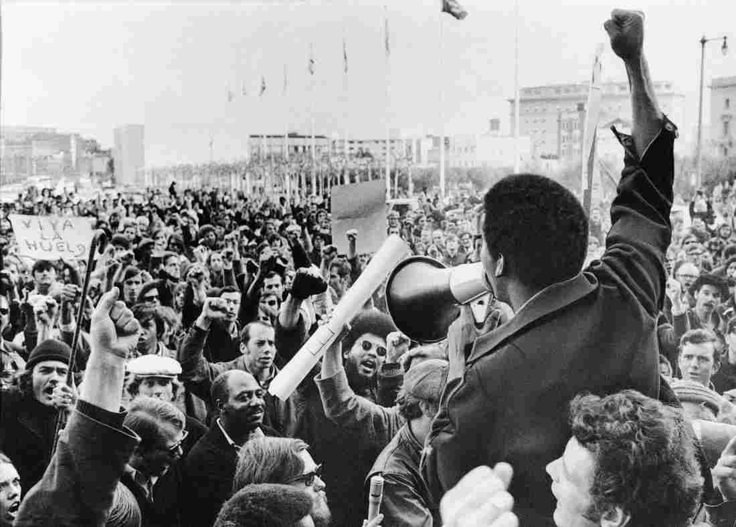
There is a popular maxim among the Nigerian student populace, often mouthed at almost every political gathering, conference or protest against fee increment. “Education is a right, not a privilege” is a quote that many students cannot defend intellectually or has translated into any meaningful reality. Whilst public education is starved of reasonable funding and slips beyond the reach of poor Nigerians, this quote rather remains in the archives of their heads, with little or no impact on the transformation of the education sector. In all honesty, the maxim is right in its entirety, and for a fact, the basis for the United Nations Sustainable Development Goal 4.
The case is sharply different when a comparative analysis is run with how students of other countries have chosen to be the catalyst for positive change in their education sector and the system at large. Across different parts of the world, particularly parts of Europe and Latin America, students are once again demonstrating that the struggle over education is beyond maxims, well-ironed kaftans and tokunbo titles of “comrade, barrister, honourable lagbaja-tamedo”. From Serbia to France, student resistance is bringing what looks like a deaf government, its actors and institutions to their knees. These developments, therefore, raise an important question for Nigeria that at a time when students all over the world are organising to challenge government decisions and defend public education, what is happening to the politics of student resistance in Nigeria, at a dire time when it is needed the most?
The student-led movement in Serbia, which emerged following the November 2024 Novi Sad railway station disaster, developed into a wider movement demanding accountability and institutional reforms. Its significance has extended beyond campus activism. In October 2026, the movement’s electoral list won 140 of the 250 seats in the Serbian parliament, demonstrating how student-led mobilisation can develop into a broader political intervention. In France, protests that began around conditions in state schools and expanded into wider concerns about education funding, university admissions, living conditions and public services have similarly demonstrated the capacity of students and young people to challenge government policies. The European Students’ Union recorded 29 protest actions across 12 countries between July and September 2026, with demands encompassing university funding, student accommodation, educational access and institutional accountability.
A sneak-peek comparison into the state of education between ‘revolting France’ and ‘peaceful Nigeria’ established that the former started its trouble with lycée pupils in poor Paris suburbs, teenagers blockading schools over crowded classrooms, not enough teachers and funding coupled with crumbling buildings. In the French context, ‘overcrowded classes’ means 36 pupils/students or more per class in high schools and an average of 29 students in French language lessons, compared with 26 across the OECD. Within days, more than a third of the country’s roughly 3,700 high schools were closed or disrupted. On 6 October, over a quarter of a million people marched, by the government’s own count. Notably, these are not undergraduates, but children who put a budget fight on the street, and the government had to answer it. On the other hand, Nigeria faces a chronic underfunding of its education sector, shortage of teachers/lecturers, dead laboratories, crowded classrooms on a scale that might make France grateful and rethink its woes. By rethinking its woes, let me cite a personal story:
When I gained admission to Obafemi Awolowo University in 2020, one of the first general classes I attended before COVID-19 brought the semester to a halt was SSC105 – Mathematics for Social Scientists 1. It was held in Ajose Lecture Theatre, a hall that should ideally house over five hundred students. However, due to the number of fresh students offering the course from faculties like social sciences, administration, education, environmental design and management, over a thousand students crammed, listening to a frustrated lecturer whose voice he himself could not hear. I found myself sitting on the stairs of the hall, furiously fanning myself with my clean notebook, and when that was not enough, I added blowing with my mouth. This and other experiences solidified my resolve that something must fundamentally change in this system.
To some of us, these movements in Serbia and France do not necessarily share identical political objectives or organisational structures. However, they demonstrate that students remain important political actors in struggles over the direction of public institutions and the distribution of social resources. Their mobilisation challenges the assumption that student politics should be confined to haggle fees with university management or seeking representation of PAs, SSAs, or youth league coordinators within government structures. Student movements can become sites of wider political contestation, particularly when the conditions of education intersect with questions of inequality, injustice and public accountability.
It would be a crime to analyse the glamorous resistance of students in various countries in Europe and, to an arguable extent, Latin America, and not talk about how militant the greatest Nigerian students, various Students’ Unions and our greatest gbagba, the National Association of Nigerian Students (NANS), used to be. From the 1978 Ali Must Go protests, when Nigerian students, under the leadership of Segun Okeowo, confronted the military government over increased education charges, to the 1989 anti-SAP protests and their role as an opposition bloc to the military junta, Nigerian students have repeatedly demonstrated their capacity to challenge government policies beyond the confines of their campuses. These struggles remind us that Nigerian student activism has never been confined to the four walls of lecture theatres; it has historically been part of the wider struggle against economic injustice, political repression and the deliberate abandonment of public welfare.
I have had my own encounters with this tradition of student resistance, participating in struggles organised under the banner of organisations who felt that NANS is dead and witnessing, firsthand, the place of student mobilisation in confronting government policies and institutional injustices. From these experiences, one thing remains clear that Nigerian students are not strangers to resistance, and NANS is certainly not without a militant history, however, history and revolutionary credentials cannot be permanent substitutes for present political action. The question, therefore, is whether Nigerian students can reclaim and sustain that tradition today, build a united national movement against the commercialisation of education and make comprehensive, publicly funded education an unavoidable demand on the Nigerian state.
One of the reasons why resistance is near-impossible against the rotting education is the introduction of education loans, known as Nigerian Education Loan Fund (NELFUND). Students have found comfort and solace within a scheme that is meant to trap them while the government shifts the burden of education from itself to students while comprehensively funding its own frivolities. We now see loans as an alternative to the government’s responsibility to adequately fund education. However, education should be understood as a social right and a public responsibility, not a financial obligation that students must carry into their working lives. The introduction of student loans as a major instrument of education financing risks normalising the idea that students and their families must individually assume the financial burden of acquiring education. Rather than institutionalising indebtedness as an answer to the challenges of educational access, Nigeria should establish a comprehensive system of publicly funded education supported by non-repayable grants, scholarships and student welfare provisions.
The most fundamental question is whether Nigeria can comprehensively finance its education sector and if you ask me a million times, my answer will remain the same that Nigeria has the capacity to fund it comprehensively and adequately. This question, however, must be approached through an examination of the country’s budgetary priorities and the political choices that determine how public resources are distributed. The Development Research and Projects Centre’s January 2026 report, Nigeria’s Education Budget in a Time of Fiscal Stress, estimates that education’s share of the federal budget declined from 7.82 per cent in 2025 to 6.15 per cent in the proposed 2026 budget. In June 2026, the Minister of Education acknowledged that federal allocations to education had historically remained between five and eight per cent, significantly below the 15–20 per cent UNESCO-referenced benchmark. This fall-short has always been the characteristics of successive administrations from 1999 till date.
These figures should provoke a broader discussion about national priorities. This is particularly evident in the administration’s spending priorities, which have attracted public criticism amid ‘renewed hope’ of economic hardship. These include the acquisition of a new presidential aircraft and luxury yacht, reports of a presidential Cadillac Escalade valued at over ₦1 billion, ₦21 billion for the renovation of the Vice-President’s residence, billion naira worth of 2026 Toyota Land Cruiser Prado SUVs for APC youth leadership . Nigeria must begin to question the justification for wasteful government expenditure, unnecessary political privileges, excessive administrative costs, extravagant official spending and other expenditures that do not in any way advance the welfare of the population.
For a government like President Tinubu’s that can mobilise enormous resources for political administration and other frivolous ‘competing’ expenditure priorities, it must also demonstrate the political commitment to adequately finance the education of its population. Widely known is that the issue is not simply about the availability of resources, but the priorities that guide their distribution. Education must be treated as an essential public investment rather than an expenditure that should increasingly be transferred to individual households or in the hands of private individuals who are also, their friends, cronies and stalwarts.
Therefore, the justifiable demand for free education must also extend beyond university tuition. At a time when the country has over ten million out-of-school children, one of the highest in the world by the way, we need a comprehensive system of free, quality and accessible education at all levels, from early childhood and basic education through secondary, technical, vocational and tertiary education. This must include adequately equipped schools, functional laboratories and libraries, sufficient and properly remunerated teachers and lecturers, accessible accommodation, learning materials, research facilities and other essential educational infrastructure. Students should also have access to publicly funded grants and welfare support without being subjected to repayment obligations. Such grants should be transparent, adequately funded and accessible as an entitlement within a publicly guaranteed education system, rather than being treated as occasional political favours.
A nation like ours that has one of the highest numbers of out-of-school children in the world sits on a soon-to-explode keg of gunpowder. The denial of quality education to millions of these children does not merely deepen the existing inequalities between the rich and the poor but reproduces poverty, widens social exclusion and creates fertile conditions for insecurity and violent extremism. While lack of education alone does not explain the terrorism that has plagued parts of Nigeria, the absence of accessible, comprehensive and quality education, alongside poverty, unemployment and state neglect, leaves vulnerable communities exposed to manipulation and recruitment by extremist groups. Every child denied an education today represents another failure to secure Nigeria’s social and political future. If the country does not urgently reverse this trend, the number of out-of-school children will continue to grow, deepening the inequalities and vulnerabilities that threaten national stability. We must understand that the greatest form of security is not necessarily found in the barrel of a gun, but in an informed and educated mind. It is an educated mind that is better equipped to question propaganda, resist manipulation, understand its rights and make informed electoral choices rather than surrender its political agency to ethnic, religious or financial inducements. A country cannot hope to secure its future by investing more in instruments of force while neglecting the minds and material conditions of its people.
To many of us who have agreed on the death of NANS and have repeatedly called for its burial, the question is whether the Nigerian students have the capacity for mobilisation necessary to represent themselves in the present circumstances. The Nigerian student movement must move beyond a politics that is limited to negotiating concessions within an education financing framework that leaves the fundamental question of public responsibility unresolved. Students’ unions, social movements across tertiary institutions and the wider student population must become catalysts for a renewed national demand for free, quality and comprehensive education. This requires a student movement capable of placing public education financing, institutional accountability and educational equality at the centre of national political debate.
The contemporary student mobilisations in Serbia, France and other parts of Europe remind us that students can still influence the political direction of their societies. Nigeria’s own history of student resistance demonstrates that student organisations have played important roles in challenging government policies and defending public education. The present challenge is to translate that tradition into a renewed demand for comprehensive public financing of education. It is only then that our variously archived maxims can inspire generations, and our tokunbo titles translate into meaningful social changes. The fate lies in our palm, the pen is in our hand to write the destiny of the present and the foreseeable future.
About
Joshua T. Oladepo is a political scientist, researcher, social activist and archivist.





This is so insightful to read. It is time for Youth and Students consciousness we need active participation ✊